“I’m Fine”: How We Learn to Hide What Hurts
A small child falls in the playground.
For a second, they do not know what has happened.
They may be hurt. They may be frightened. They may be embarrassed. They may simply be shocked by the suddenness of the fall.
So they look up.
They look to the adult nearby, searching for information.
What just happened?
Am I safe?
Is this bad?
What do I do with this feeling?
And the adult says:
“Up you get. You’re fine.”
Often, the adult is trying to help.
They may be trying to teach perspective. They may be trying to stop the child becoming frightened. They may be trying to build resilience. They may be repeating what was said to them when they were small.
Brush yourself off.
Don’t make a fuss.
Other people have it worse.
You’re fine.
But the child may not learn, “falling over is no big deal.”
They may learn something much deeper.
They may learn:
What I feel does not matter.
My reaction is too much.
I am silly for feeling this.
I must deal with this alone.
I should hide what hurts.
And, over time, “I’m fine” can become less of an answer and more of a reflex.
This is not about blaming parents
It is important to say this clearly.
This is not about blaming parents for every imperfect response.
Most parents do not get this right all the time. Many loving, caring adults have said “you’re fine” because they genuinely believed they were helping. They may have been trying to teach strength, perspective, resilience, or proportion.
They may also have grown up with the same messages themselves.
Many of today’s adults were raised by parents who had been taught, directly or indirectly, that feelings were inconvenient, excessive, self-indulgent, or weak. In families shaped by war, poverty, emotional neglect, strict discipline, instability, or survival, “be strong” may not have been a slogan. It may have been the only available strategy.
So this is not about shaming parents.
It is about understanding patterns.
Because repeated emotional minimising, even when well-intentioned, can shape a person’s relationship with feeling.
A child may learn that some feelings are acceptable and others are not. They may learn that distress should be hidden. They may learn that needing comfort is embarrassing. They may learn that pain only counts if someone else agrees it is serious enough.
And if no one helps them process what they feel, the feeling does not simply disappear.
It goes somewhere.
When “I’m fine” becomes a survival strategy
Some people say “I’m fine” before they know whether they are.
It arrives automatically.
Someone asks how you are, and the answer is already there.
Fine.
Not because you have checked in with yourself.
Not because you feel settled, clear, and well.
But because “fine” is safe.
Fine asks nothing of anyone.
Fine keeps things moving.
Fine does not make a scene.
Fine does not need comfort.
Fine does not risk being dismissed.
There is an old joke that F.I.N.E. stands for “freaked out, insecure, neurotic, and emotional.”
It makes me smile because, for many people, “I’m fine” does not mean nothing is happening.
It means something is happening, but they have learned not to show it.
From the outside, this person may look calm, capable, sensible, and composed.
Underneath, it may be more like a duck on water: smooth on the surface, legs paddling frantically below.
They may not know what they feel.
They may explain instead of feel.
They may become anxious, controlled, planned, or highly organised because surprise feels dangerous.
They may be startled by their own strong reaction to someone else having feelings, then quickly squash that reaction too.
They may allow themselves one or two “acceptable” emotions, such as anger, anxiety, or competence, while sadness, fear, tenderness, need, grief, disappointment, or longing are pushed out of sight.
They may seem very resilient.
But sometimes what looks like resilience is actually suppression.
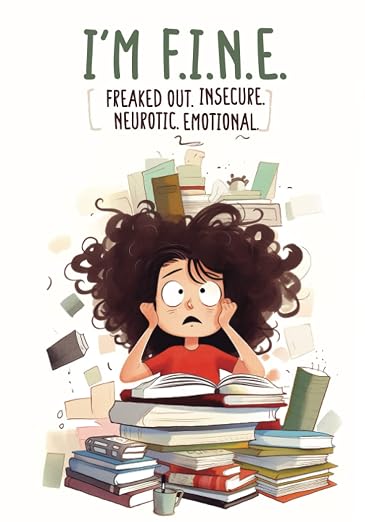
I found this adorable journal on Amazon – seems fitting for today’s post… and the perfect way to get ready for the new academic year.
Resilience is not the absence of feeling
Real resilience is not the absence of feeling.
It is the capacity to feel, with enough support, safety, and regulation to stay present.
There is a big difference between:
“I can feel this, and I have enough support to get through it.”
and:
“I must not feel this because it is unsafe, shameful, pointless, or not allowed.”
The first is resilience.
The second is what Transactional Analysis might describe as a Don’t Feel injunction.
In plain language, it is an early rule that says feelings are dangerous, unacceptable, pointless, or too much.
Don’t Feel might sound like:
Don’t be silly.
Don’t make a fuss.
You’re too sensitive.
There’s nothing to be upset about.
Other people have it worse.
Stop crying.
You’re fine.
That last one can be especially powerful, because it does not only dismiss the feeling. It replaces the person’s inner experience with someone else’s version of reality.
You feel upset.
Someone else says you are fine.
If that happens often enough, especially when you are small, you may stop trusting what you feel.
Don’t Feel and Be Strong
Don’t Feel often travels with another old pattern: Be Strong.
Don’t Feel says:
“I am not allowed to feel.”
Be Strong says:
“I must not need help, comfort, tenderness, or support.”
Together, they can become a powerful rule:
If I am not allowed to feel, perhaps it is because I do not need to feel.
And if I do not need to feel, perhaps that means I am strong.
For some people, this becomes part of their identity.
They are the strong one.
The capable one.
The one who copes.
The one who does not fall apart.
The one who is fine.
But being unable to feel, or unable to show feeling, is not the same as being free.
It may be protection.
It may have helped you survive.
It may have helped you stay acceptable in a family, school, workplace, or relationship where feelings were not welcome.
But it may also leave you very alone.
Not allowed, or no point
There are different versions of Don’t Feel.
For some people, the message is:
“You are not allowed to feel.”
This may come from families where feelings were judged, mocked, punished, or minimised. The child learns that feeling breaks the rules. Showing distress may lead to shame, trouble, irritation, rejection, or withdrawal.
For others, the message is:
“There is no point in feeling.”
This can happen when distress is repeatedly met with nothing.
No comfort.
No response.
No repair.
No one coming.
For a very young child, that can become unbearable.
They may not think, “My parent is overwhelmed,” or “My caregiver does not have the resources to respond.”
Children tend to make meaning through themselves.
So the meaning may become:
My need is wrong.
My feeling is too much.
No one comes because I do not deserve help.
If I show what I feel, people will discover something shameful about me.
That is a devastating kind of loneliness.
And because the child cannot safely blame the caregiver they depend on, they may blame themselves instead.
This is not conscious.
It is survival.
If the adult must be good, then the badness must live in me.
So the feeling gets locked away.
Not because it has gone.
Because there was no safe place for it to be.
Worst is worst
We often measure pain against an external scale.
A bereavement counts.
A cancer diagnosis counts.
A serious accident counts.
A fall in the playground does not count.
A paper cut does not count.
A small embarrassment does not count.
Of course, some experiences are objectively more serious than others.
But human pain is not only measured from the outside.
It is also shaped by capacity, history, age, support, resources, nervous system state, and whether anyone is there to witness what happened.
Something that seems small to one person may overwhelm another person’s system, especially if they are alone with it.
This is one reason I find some trauma-informed approaches helpful. Dr Aimie Apigian, for example, describes trauma through the body’s capacity to process and recover, rather than only through the external size of the event. Her work in The Biology of Trauma explores trauma as something that lives in the body and nervous system, not only in the story of what happened.
That does not mean every painful experience is “Big-T Trauma.”
It means we need more humility about what another person’s system could, or could not, hold at the time.
Sometimes worst is worst.
Not because no one else has suffered more.
But because, for that person, in that moment, with those resources, it was too much to hold alone.
What validation can look like
So what might the child in the playground need?
Not panic.
Not drama.
Not an adult collapsing into fear beside them.
But presence.
Something like:
“Oh, that looked like a shock. Come here. Are you hurt? What happened? Shall we take a breath together?”
The adult might help the child find words.
Was it scary?
Did it hurt?
Did you feel silly?
Are you angry that it happened?
Did it surprise you?
Some children might need language. Some might need pictures. Some might need to point to a face that looks like how they feel. Some might need to notice where the feeling is in their body. Some might need to draw it, move it, shake it out, or imagine its colour.
The point is not to make the feeling bigger.
The point is to make it safe enough to notice.
A child who is allowed to feel can also learn choice.
Feelings are allowed.
Behaviour still has choices.
You can feel angry, and choose not to hit.
You can feel frightened, and choose to ask for help.
You can feel embarrassed, and choose whether to try again now or later.
You can feel sad, and let someone comfort you.
That is resilience.
Not “nothing happened.”
Something happened, and I had enough support to feel it, understand it, and recover.
What does “feel your feelings” actually mean?
“Feel your feelings” is one of those phrases that sounds simple until you try to do it.
Especially if you learned not to feel.
If your whole system has been organised around not knowing, not needing, not reacting, not making a fuss, and not being too much, then “feel your feelings” can sound almost absurd.
What am I supposed to do?
Where do I start?
How do I know if I am doing it right?
Feeling your feelings does not mean forcing yourself open.
It does not mean drowning in emotion.
It does not mean dramatising, spiralling, or telling yourself stories until you feel worse.
It might begin much more gently.
What do I notice?
Where do I notice it?
Is there a tightness, heaviness, buzzing, heat, pressure, numbness, or ache?
If it had a colour, what colour might it be?
If I looked at a feelings wheel, which word might be closest?
What happens if I let this feeling exist for a few moments without fixing it?
For people with strong Don’t Feel patterns, there may also be an internal protector that becomes alarmed when feelings appear.
In Transactional Analysis language, we might think of this as a Parent ego state trying to protect the Child from danger.
The Adult part of you may need to stay present and reassuring.
Something like:
“It’s okay. We are not going to flood ourselves. We are not going to open everything at once. I am here. We can notice this feeling gently. We can stop if it becomes too much.”
You do not have to open the whole box at once.
How therapy can help
Therapy can offer a place to experiment with feeling safely.
Not all at once.
Not without care.
Not by forcing open what has been locked away for good reason.
But slowly, with support, curiosity, and attention to what feels tolerable.
In therapy, we can begin to explore:
What feels safe to say?
What feels unsafe to say?
What happens when a feeling appears?
What do you do automatically?
Do you explain it away?
Laugh it off?
Disappear?
Become angry?
Become anxious?
Go blank?
Say “I’m fine”?
We can also build capacity.
There is a concept called the Window of Tolerance, which describes the zone where we can feel, think, connect, and process without becoming overwhelmed or shutting down. That deserves its own article, but the short version is this: therapy can help you notice when you are inside that window, when you are leaving it, and what helps you come back.
Over time, feelings may become less like floods and more like information.
Still powerful.
Still sometimes painful.
But less impossible to survive.
A good therapeutic relationship can also offer something many people with Don’t Feel did not have enough of earlier in life: witnessing.
Someone else sits with you while you feel.
Someone does not rush you to be fine.
Someone does not tell you other people have it worse.
Someone helps you notice that the feeling rises, changes, and passes.
Someone helps you discover that you can feel something and still remain here.
If opening the box feels frightening
If you have spent years, or decades, not feeling, it can be frightening when feelings start to return.
You may worry that if you open the box, everything will come out at once.
Sometimes it can feel that way.
Old sadness.
Old anger.
Old fear.
Old grief.
Old shame.
Old needs that never had anywhere to go.
If this happens, it does not mean you are doing therapy wrong.
It does not mean you are broken.
It does not mean you should have kept the box locked forever.
It may mean you need support, pacing, grounding, and time.
The old rule may say:
“This is too much. See? This is why we don’t feel.”
But familiar does not always mean true.
It may simply mean this is the rule your system learned a long time ago.
You are allowed to go slowly.
You are allowed to need help.
You are allowed to build the capacity you were not given.
A reflection for this week
If this resonates, begin gently.
You do not need to dig up your deepest feelings alone.
You do not need to force anything open.
You might simply notice:
Where do I say “I’m fine” before I know if I am?
What happens in my body when someone asks how I feel?
You might also try a simple grounding practice.
Look around and name:
- 5 things you can see
- 4 things you can feel
- 3 things you can hear
- 2 things you can smell
- 1 thing you can taste, or one slow breath you can take
This is not a test.
It is not a technique for making feelings disappear.
It is a way of gently reminding your body that you are here, now, in this moment.
You do not have to force a feeling to appear.
You are simply practising being present enough to notice what is already there.
And if what is there feels too much to meet alone, that matters.
You do not have to keep saying “I’m fine” forever.
With the right support, it can become safe to feel a little bit more.